SEO, AEO and GEO: which of these is a real distinction
Two of these three terms were invented by the marketing industry, not by search engines. What each describes, where the work genuinely differs, and where it does not.
Entrovix AIAug 10, 2026 9 min read
Start with the part nobody selling a GEO package will lead with. Search engine optimisation describes a thing search engines do. Answer engine optimisation and generative engine optimisation describe things the marketing industry decided to call something.
No search engine runs a programme by either name. There is no AEO documentation, no GEO guidelines, and no Google statement acknowledging either as a distinct discipline. What there is, on the contrary, is Google stating plainly that no special optimisation is necessary for its AI features.
That does not make the terms worthless. They point at real shifts. It does mean you should know which parts describe new work and which parts are a relabelling exercise.
What each term is pointing at
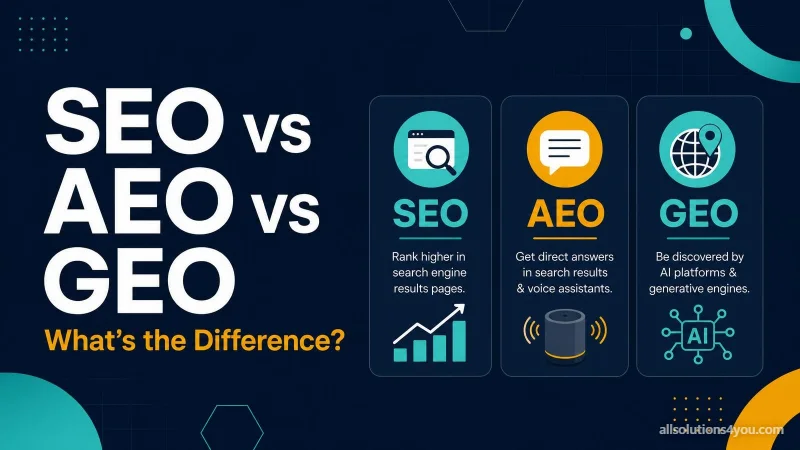
| Term | The claim | What it actually asks you to do |
|---|---|---|
| SEO | Be findable and rank in search results | Be crawlable, indexable, relevant, and better than the alternatives |
| AEO | Be the direct answer, in featured snippets and voice results | Answer questions plainly, near the top, under a heading that asks them |
| GEO | Be cited by generative systems like AI Overviews and chat assistants | Be indexed, be extractable, be worth quoting, be attributable |
Read the third column on its own and the overlap is obvious. Two of the three rows are a subset of the first, expressed as a specialism.
Where the work is genuinely the same
All three depend on the same foundation, and the foundation is not optional for any of them.
- The page has to be crawlable and indexed. Google has confirmed that AI feature eligibility requires exactly this, plus snippet eligibility.
- The content has to be in text. A machine cannot extract an answer from an image of a table.
- The site has to be reachable and reasonably fast, because none of these systems favour pages they struggle to fetch.
- The content has to actually be good, because every one of these systems is trying to identify the same thing.
If your pages are not indexed, all three disciplines return the same answer, and it is the not ranking checklist.
Where there is a genuine difference
Three differences survive scrutiny. They are smaller than the terminology implies, and they are worth acting on.
1. The unit that gets used is the passage, not the page
A ranking result is a page. An extracted answer is a few sentences. That shifts some effort from page-level structure to making individual passages self-contained, so a paragraph lifted out of context still says something true and complete.
2. The click is no longer the only outcome
Being cited without being clicked has some value, and it is value your analytics cannot see. Google's generative AI reports in Search Console show impressions but no clicks, which is an unusually honest admission that the old measurement does not fit.
3. Being quotable matters more than being comprehensive
A 4,000-word page that buries its answer in the middle is poor raw material for extraction. Specific, attributable statements are better. That is a real change in emphasis away from the length-as-quality habit that a decade of SEO advice encouraged.
What to ignore
Some of what is sold under these labels has been directly contradicted by the search engine it claims to optimise for.
- llms.txt files. Google's Search team has said publicly that Search does not use them and is not planning to.
- AI-specific markup. Google states you do not need new machine-readable files or markup for its AI features.
- FAQ schema added for rich results. Google stopped showing FAQ rich results in May 2026 and dropped support for the feature. The markup is still valid; it just no longer produces the thing it was added for.
- Anybody quoting a guaranteed citation rate. There is no published mechanism, so a guarantee is a sales device.
A discipline whose defining tactic has been publicly disowned by the engine it claims to optimise for is not a discipline yet. It is a category waiting to see whether it turns out to exist.
A reasonable position to take
Do the SEO. It is the prerequisite for all three by the search engine's own account. Then apply the two changes in emphasis that genuinely follow from how answers get extracted, both of which improve the page for human readers anyway.
- 1Put the answer to a heading's question directly underneath it, then expand. Do not warm up.
- 2Make individual sections make sense on their own, because that is the unit that gets quoted.
- 3Keep facts in text rather than in images or embedded widgets.
- 4Be specific enough to be worth citing, and clear enough about who is saying it to be worth trusting.
- 5Stop buying anything sold specifically as AEO or GEO until somebody can name the mechanism it acts on.
Questions people actually ask
Do I need a separate GEO strategy?
No, on the current evidence. You need the SEO foundations and a writing habit that puts answers where they can be found. If a search engine publishes distinct requirements later, that would change, and it would be documented rather than inferred.
Is AEO the same as optimising for featured snippets?
Essentially, yes, extended to voice assistants and AI summaries. Featured snippet practice — a clear question heading, a direct 40-to-60-word answer, a table or list where the query implies one — is most of what the term describes, and it predates it by a decade.
My traffic is falling. Is that AI?
Check before assuming. Compare the drop against confirmed core update dates, check Search Console for indexing changes, and look at whether the fall is spread across the site or concentrated in informational pages. Those three checks separate an AI-driven decline from an ordinary one, and the fixes are different.
Should I stop writing informational content?
No, but be honest about which pieces exist to earn traffic and which exist to earn trust. The second kind is largely unaffected. Content that gets traffic and generates leads covers how to tell them apart before you commission twenty more articles.