How many keywords should one page target?
One page, one question, and every phrasing of it. Here is the free two-minute test that settles whether two keywords belong on the same page or not.
Entrovix AIAug 23, 2026 10 min read

The question has a number in it, so it usually gets answered with a number. Three to five per page. One primary and two secondary. Seven, if you read a certain kind of advice. All of those numbers are invented.
Nothing in Google's systems reads a list of keywords you assigned to a page. There is no field for it, no counter, no slot. A page has words in it, and those words either answer what somebody typed or they do not. So the number you are actually looking for is not a keyword count.
The two-minute version
One page should answer one question, and it should contain every natural phrasing of that question. That is the whole rule. If you insist on a number: one primary phrasing, plus as many variants as honest writing produces, which for a decent page is routinely dozens and sometimes hundreds that nobody assigned to it.
The only real decision left is whether two terms are one question or two. There is a free test for that. It takes two minutes and it settles arguments.
The test: compare the two first pages
Open Google. Search the first term. Search the second term. Compare the top ten URLs of each.
- 1Most of the URLs are the same on both searches: Google has already decided these are one question. Build one page and cover both phrasings inside it.
- 2The URLs barely overlap: these are different questions expecting different answers. Build two pages.
- 3Roughly half overlap: look at what the shared results are. If a single page ranks for both because it genuinely covers both, do that. If the only overlap is the big brands that rank for everything in the niche, treat the terms as separate.
Run it logged out or in a private window so your own history is not shaping the results, and check it on mobile too if the two terms feel commercially different. While you are looking, read the titles of the shared results. When one page ranks for both terms and its title contains only one of them, you are looking at direct proof that a page does not need a phrase in its title to rank for that phrase.
This beats every tool, including ours, because it reads Google's actual judgement instead of estimating it.
Why targeting keywords is the wrong frame
The phrase implies an assignment step: you pick terms, you place them, the page collects rankings for what you placed. Pages do not behave that way. A page that thoroughly answers one question also ranks for the reversed word order, the misspelling, the version with "how do I" in front, the version with a year appended, and a long list of phrasings nobody would have thought to write down.
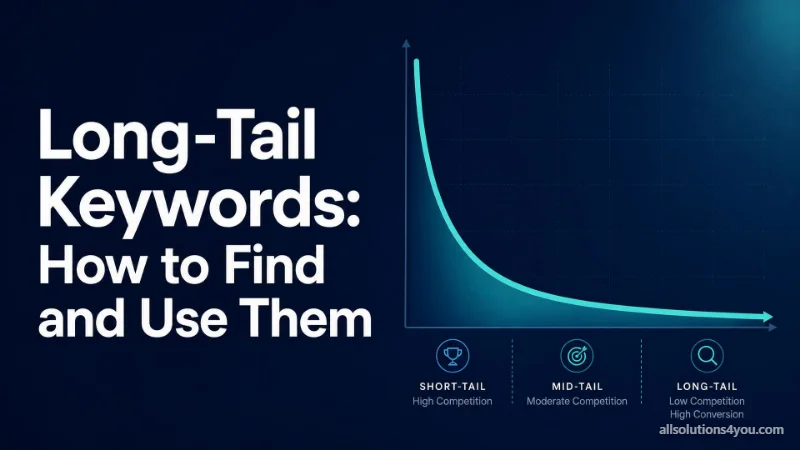
That list is where most of the traffic to a good page comes from. Long-tail keywords are not something you allocate one per page. They are what a page earns once it answers the core question properly.
Which makes the planning unit a question with an intent attached, not a string. Two terms that look almost identical can carry different intents, and intent decides page count more often than wording does. "Buy X" and "what is X" share three characters and nothing else.
The split failure: two pages for one question
This is the common and expensive mistake. Somebody has a list of forty keywords, decides each one deserves a page, and publishes "running shoes for flat feet", "best running shoes for flat feet" and "flat feet running shoes" as three separate articles.
Google now has to choose between them. It picks one, sometimes a different one week to week, and the other two sit unranked while splitting whatever links and internal signals were pointing at the topic. That is keyword cannibalization, and the fix is nearly always a merge and a redirect rather than more optimisation on any of the three.
- Two of your URLs trade places for the same query in the Search Console (opens in a new tab) performance report.
- A page collects impressions but its average position hovers in the teens and never improves.
- You cannot explain in one sentence how two of your pages differ.
- Both pages feel thin, because there was only ever one article's worth of material.
The cram failure: one page for many questions
The opposite error, and easier to spot. A single services page covering web design, hosting, logo work and photography ranks for none of them well, because every extra topic pulls the page further from being the best answer to any one query. A reader who searched for one of the four skims past three quarters of it and leaves.
There is a quick diagnostic. If you cannot write a title tag under about sixty characters that honestly describes the page, the page is about too many things.
Split or merge: the signals
| Signals you should split | Signals you should merge |
|---|---|
| The two searches return mostly different URLs. | The two searches return mostly the same URLs. |
| The result formats differ: product pages for one, explainers for the other. | Both first pages are the same format, same depth, same angle. |
| A reader arriving on term A would skim past most of what term B needs. | A reader arriving on either term wants the same answer in the same order. |
| You can write a full, non-repetitive page for each without restating the other. | The second page would mostly reword the first. |
| Two of your pages already rank for clearly different queries and neither is stuck. | Two of your pages swap positions for the same query and both sit in the teens. |
| The next step differs: one ends in a quote request, the other in a newsletter signup. | The next step is identical for both. |
What to do with a keyword list you already have
- 1Sort it alphabetically. Near-duplicates land next to each other and a chunk of the list collapses on sight.
- 2Group by the answer, not the wording. "Cost of X" and "X price" want the same answer. "Cost of X" and "is X worth it" do not.
- 3For every pair you are unsure about, run the two-first-pages test. Ten pairs is twenty minutes of work.
- 4Count the groups. That is your page count, and it is usually far smaller than the keyword count.
- 5Give each group one primary phrasing, the one a customer would say out loud, and write the page to answer that.
Where the primary phrasing genuinely belongs
Once you have decided what question a page answers, placement is a five-minute job you then stop thinking about.
- 1The title tag. The clearest phrasing of the question, in the words a person would type, near the front.
- 2The H1. Usually the same question written for a human rather than a search box. It does not need to match the title exactly.
- 3The first paragraph. Not because anything counts it, but because a reader who landed from that query needs confirmation in two lines that they are in the right place.
- 4One or two subheadings, where a variant of the phrasing is the honest name for that section.
- 5The URL slug, short and readable, if you are creating the page now. Do not rewrite working URLs for this.
There is no sixth place. Everything after that is writing: answer the question completely, use the words the answer actually needs, and the variants show up by themselves because that is how language works. Meta descriptions are not a ranking input, and a keyword jammed into image alt text describes nothing to a screen reader. Write alt text about the image.
There is no keyword density target
Not one percent, not two, not three mentions per five hundred words. Google has never published a density target and does not use one, and the idea stopped being a plausible model of relevance long before most of the advice about it was written. Meta keywords are ignored as well. If a checklist hands you a percentage, the checklist is old.
Density measurement is still worth something, but in the opposite direction. If you wrote fourteen hundred words meant to answer one question and the phrase for that question appears exactly once, in the title, something went wrong with the article rather than with the optimisation. Usually the writer answered a neighbouring question instead and did not notice.
It catches the other failure too. A phrase repeated so often that sentences are visibly built around it shows up in a word count before it shows up to the author, because by the third pass you have stopped reading your own draft.
A worked count
Take this page. Its question is how many keywords one page should target. Phrasings that belong here without any planning at all: how many keywords per page, how many keywords per blog post, how many keywords per article, can one page target two keywords, should every keyword have its own page. Same question, different mouths. One page.
Now take keyword difficulty. It sounds adjacent, and a keyword tool would happily put it in the same cluster. Search it and the first page fills with metric explainers and tool documentation that overlap almost nothing with the results for this question. Different question, different page, which is why what keyword difficulty means lives somewhere else.
The right number is one question per page, and however many ways people ask it.
Questions people actually ask
Can one page rank for two different keywords?
Routinely, and usually for far more than two. A page that answers its question well collects rankings for phrasings nobody assigned to it. The constraint is not a count, it is coherence: two keywords can share a page when they share an answer.
Should every keyword have its own page?
No, and that belief is the main cause of bloated sites where nothing ranks. Terms that Google answers with the same results should share one page. Run the two-first-pages test before you create anything, not after you have published three near-duplicates.
How many times should the keyword appear?
As many times as the writing needs, and no more. Title, H1, the opening lines, and any heading where it is the honest label for that section. After that, count nothing. The urge to insert it one more time is the signal to stop.
What about secondary keywords?
Treat them as a checklist of things the page must genuinely cover, not as slots to fill. If cost is a secondary term, the page needs a section that answers the cost question properly. If it cannot, that term belongs to a different page.
Does any of this change for AI Overviews and AI Mode?
No. Google has said there are no additional requirements to appear in AI Overviews or AI Mode, nor other special optimisations necessary. The unit is still one page that clearly answers one question, which is convenient, because that was already the answer. Showing up in AI search mostly means doing this part well.