Long-tail keywords: how to find them and how to use them
Long-tail does not mean long phrase. It means low search volume. What the demand curve really is, where to find these queries free, and how to use them.
Entrovix AIAug 22, 2026 11 min read
Long-tail keywords are not long. That is the whole confusion and it comes straight from the name. The word tail describes the shape of a graph, not the shape of a phrase, and once you know which graph it is, a lot of common long-tail advice starts to look backwards.
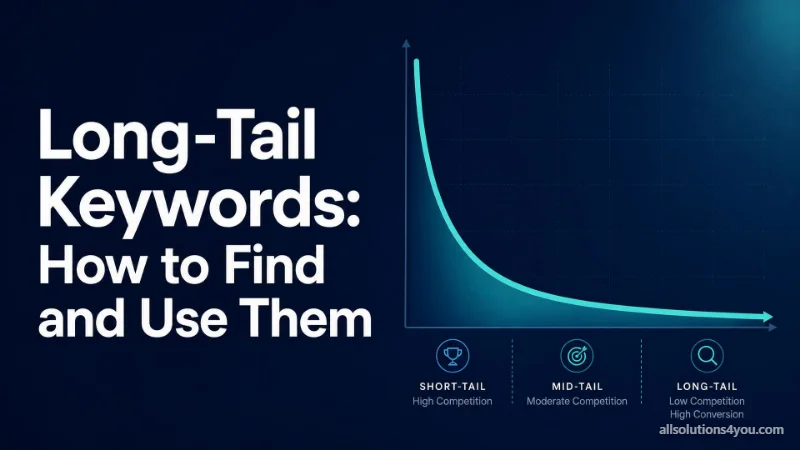
Here is the graph. Take every query typed into a search engine in a month and line them up in order of how often each one is searched. You get a curve that falls off a cliff almost immediately and then refuses to touch zero. The cliff is the head. The part that runs on and on to the right, never quite ending, is the tail. A long-tail keyword is a query sitting out in that low-volume stretch. Word count has nothing to do with it.
The two-minute version
Long-tail means low search volume. A three-word query can be long-tail and a seven-word query can be a head term. The tail is worth your attention because there is more total demand spread across it than sits in the head, it is divided among a huge number of distinct queries, and each of those queries is specific enough that a small site can genuinely win it. The way to capture the tail is not one page per phrase. It is one page that answers one question so thoroughly that it matches dozens of ways of asking it.
The curve, concretely
Pick any industry. A handful of terms carry enormous volume: the category name, the bare product name, the two-word query everybody in the trade already knows. Below those sits a middle band of qualified versions, with a city attached or a use case or a price question. Below that, running much further than most people picture, are queries searched a few dozen times a month. Then a few times a year. Then once, by one person, who will never type it again.
That last stretch is why the tail cannot be fully researched in advance. Part of it does not exist in any tool's database because it has not been asked yet. You do not target those queries. You earn them by having a page that happens to answer the question, and then you find out about them afterwards in your own reports.
| Band | Example query | Words | How it behaves |
|---|---|---|---|
| Head | "web design" | 2 | Huge volume, no usable intent signal, held by sites with a decade of history. |
| Middle | "web design company in Jaipur" | 5 | Real volume, clear intent, competitive but not hopeless for a local business. |
| Tail | "can I move my Wix site to WordPress" | 8 | Small volume, obvious intent, one clear answer, thin competition. |
| Long despite being head | "how to take a screenshot on a mac" | 8 | Enormous volume. Eight words and not remotely long-tail. |
| Short despite being tail | "teak sideboard restoration" | 3 | Barely searched, plainly commercial if that is your trade. |
The last two rows are the point. Length correlates loosely with low volume, because people who type more words are usually asking something narrower. Correlation is not the definition.
Why the misdefinition costs you money
If you believe long-tail means long, you start hunting for phrases with more words in them. That is a completely different exercise from hunting for queries with less competition, and it produces the pages nobody reads. You end up writing for "affordable professional web design services company", a string of words no human has ever said out loud, while ignoring "website not showing up on google", which is five words, modest volume, and a person with a problem you could solve this afternoon.
The other cost is stuffing. Once a phrase becomes the target rather than the question, the temptation is to work every variant of it into the copy so the page matches all of them. Search engines match meaning now, not strings, so this achieves nothing except making the page read like it was written for a machine.
Why the tail is worth having when your site is small
- You can actually win. A query whose first page is two forum threads and a 2019 blog post is undefended ground. Nobody built that page on purpose, which means one honest page can take it.
- The searcher is further along. Someone asking a narrow question has usually stopped browsing and started deciding. Head terms collect the curious; the tail collects people with a specific situation.
- You know exactly what to write. A broad term leaves you guessing at what the page should contain. A specific question tells you.
- It compounds. One page can rank for thirty small queries at once, and each new page adds to a total that does not depend on any single ranking holding up.
- You see movement early. Impressions for specific queries tend to show up in weeks rather than the many months a head term takes to budge, which makes the work possible to evaluate before you have spent a year on it.
When a long-tail keyword is not worth a page
Three failure cases, and the first is the expensive one.
- 1No commercial relevance. The query is easy and specific and the person asking it will never buy anything from you. An accountant ranking first for a question about a spreadsheet keyboard shortcut has won nothing.
- 2Nobody searches it at all. Genuinely zero, not just low. Tool suggestion lists are full of grammatically assembled phrases that no person has typed. So are the lists people write themselves.
- 3You already answer it. If the query is a rephrasing of something an existing page covers, the correct action is to add a subheading to that page, or nothing at all.
Telling case two apart from a real low-volume query is easy and free. Type it into Google. If autocomplete does not offer anything close to it, and the results that come back are about something else, that phrase is not a query. It is a construction. Compare that with a real tail query, where autocomplete completes it before you finish typing and the results are all clearly attempting the same answer. Intent matters more than volume here, and what search intent actually means is the filter to apply before any of this.
Where to find them without paying for data
In rough order of how much they repay the effort.
Your own Search Console, first
This is the best long-tail source that exists for your site specifically, and it costs nothing. The Performance report in Search Console (opens in a new tab) lists the queries you already appear for, including the many you never targeted. Sort by impressions with few or no clicks. Filter for queries containing a question word. Look at everything sitting between position 8 and 25. Those are queries the search engine has already decided you are relevant to, which is a shorter distance to close than starting from nothing.
Every query in that list is proof of real demand, which no volume estimate can give you. Somebody typed it, and the report is counting them.
Autocomplete, People Also Ask, related searches
Type your core term and read the suggestions without pressing enter. Then press enter and read the People Also Ask box and the related searches at the bottom. Expand a PAA question and more appear. These come from real query behaviour, which puts them well ahead of a generated suggestion list, and they are free. Do it in a private window with the location set to where your customers are.
The words your customers actually use
Sales calls, enquiry forms, support email, the thing three different people asked last month. These are queries with proven commercial relevance, phrased the way a customer phrases it rather than the way the industry does. That gap between customer language and trade language is where the least contested queries live, because the trade writes in trade words.
Forums and one-star reviews
Reddit threads, trade forums, and the bad reviews of your competitors' products. People describe problems there before they have learned the correct term for them, which is exactly the vocabulary they use when they search.
A warning about the volume numbers
Every free search volume figure you will see is a model's output, rounded into a bucket, and it is least reliable precisely where the tail lives. A tool showing 0 usually means below the threshold this tool bothers to estimate, not nobody searches this. Treat a zero as unknown rather than as a verdict, and settle it by looking at the search results yourself. Two tools disagreeing by a factor of ten on the same query is normal and tells you what kind of number it is.
Long-tail patterns and what they signal
Tail queries fall into recognisable shapes, and the shape tells you what the page has to be. Get this wrong and you can rank without ever satisfying anybody.
| Pattern | What it signals | What the page must do |
|---|---|---|
| "why is my X doing Y" | Something is broken and they want the cause, not a lecture | Name the likely causes in the opening lines, then the fixes in order of probability. |
| "how to X without Y" | A hard constraint, usually money, time, or a tool they do not have | Respect the constraint. An answer that quietly requires Y has failed. |
| "is X worth it" / "do I need X" | Pre-purchase doubt, close to a decision | Answer honestly, including the cases where it is not worth it. |
| "X vs Y for Z" | A comparison already narrowed by a use case, so intent is high | Pick one for that use case. Studied neutrality reads as evasion. |
| "can I X" | A feasibility or permission check | Yes or no in the first sentence. Conditions afterwards. |
| "X in [town]" / "X near me" | Hiring intent, now | A service page for that area, not an article about the topic. |
How to use them: one page, many phrasings
The instinct after a good research session is one page per phrase. Forty phrases, forty pages, forty rankings. It does not work that way, and it is the single most common way a small site damages itself.
Pages built from near-identical phrasings compete with each other. Search engines have to choose which of your six pages answers the question, they choose one, and the others sit there diluting the internal links and the topical signal that should have been pointing at a single strong page. That is keyword cannibalization, and long-tail keyword lists are its most reliable cause.
One page answering one question thoroughly picks up dozens of variants without being asked to. It ranks for phrasings you never wrote down, because the match is on meaning. This is the whole mechanism by which the tail gets captured, and it means the number of pages you need is closer to the number of distinct questions than to the number of phrases in your spreadsheet.
The working method, once the list is grouped:
- 1Confirm the grouping by hand for anything you are unsure about. Search two phrases and compare the first pages. Mostly the same URLs means one question and one page. Different URLs means two pages.
- 2Choose as the title the phrasing a real person would say. That is usually the plainest version, not the one with the most words in it.
- 3Answer the question properly in the first hundred words. Tail visitors arrived with one specific thing to find out and they will leave if the answer is below a preamble.
- 4Cover the variants as subheadings: the exceptions, the what-ifs, the version for a slightly different situation. Each of those is a section, not a new page.
- 5Add the part only you can add. The actual figure, the screenshot, the local rule, the reason the standard advice fails in your trade. This is the difference between a page that ranks and a page that gets shared.
- 6Link it from the broader page on the topic, and from any page where the question naturally comes up in passing.
- 7Leave it alone for a month, then read which queries it actually attracted. Those queries are the subheadings for the next revision, and they are better than anything you could have guessed.
The tail is not where you find one big win. It is where thirty small ones quietly stack up while nobody is watching.
Questions people actually ask
How many words makes a keyword long-tail?
There is no number, because word count is not the criterion. Low search volume is. A three-word query in a small trade is long-tail. A seven-word question asked by a million people a month is a head term wearing a long coat. If someone tells you four words or more is long-tail, they have learned the phrase without learning the graph.
Do long-tail keywords still work now that AI answers appear in search?
They work differently depending on the question. A query with one factual answer can be summarised at the top of the results, and the click may not follow. What holds up is anything where the answer depends on the reader's own situation, anything requiring judgement, and anything where the next step is hiring or buying. Worth knowing: Search Console's generative AI performance reporting shows impressions, pages, countries, devices and dates, but no click data, so you can see that you appeared without knowing what it earned you.
Should I check search volume before writing?
Look at it, do not obey it. Use it to tell a query with some demand apart from a phrase with none, and stop there. The free numbers are modelled and bucketed and weakest at the low end, which is the whole range you are working in. A query you know three customers asked last week beats a query a tool scored at 40 a month.
How many long-tail pages should a small site have?
Fewer than the spreadsheet suggests. One page per question you can answer better than whatever currently ranks, and no pages for questions you cannot. Ten strong pages will out-earn eighty thin ones, and eighty thin ones will actively hold each other down. The related question of how many keywords one page should target is the other half of this.
Is long-tail the same thing as low competition?
Usually, not always. Low volume tends to mean fewer people bothered to compete, but some tiny queries are fiercely contested because the buyer is worth a great deal. Volume and difficulty are separate axes, and how to find low-competition keywords that bring customers covers judging the second one without paid data.