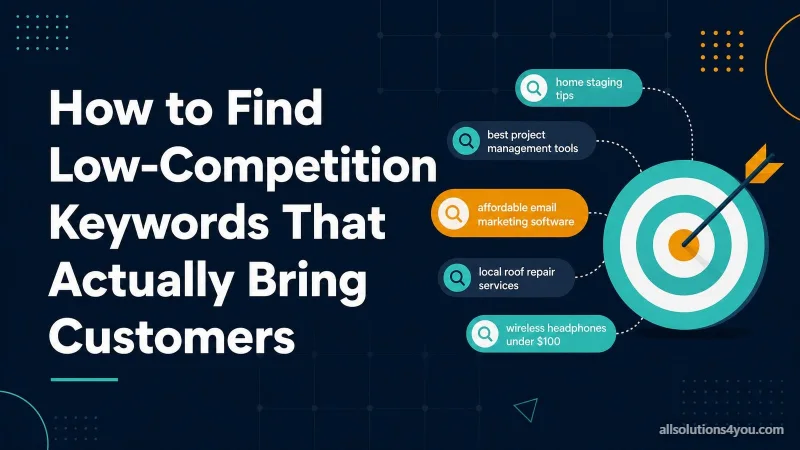
How to find low-competition keywords that bring customers
Low competition and worth ranking for are two different tests. How to apply both, where to find candidates free, and how to check before you commit.
Entrovix AIAug 9, 2026 11 min read
There are two questions about any keyword, and people usually only ask one of them. Can I realistically rank for this? And if I did, would anything happen?
Ask only the first and you end up with a spreadsheet of easy terms nobody searches with a wallet open. Ask only the second and you spend a year losing to sites with a decade of history. The keywords worth having sit where both answers are yes, and there are fewer of them than any tool suggests.
The short version
Take every candidate through two filters in this order. First: does somebody searching this have a problem I am paid to solve? Second: does the current first page contain at least one site no bigger than mine? A term that fails the first is not worth winning. A term that fails the second is not winnable this year.
Why low competition on its own is a trap
It is easy to find terms with almost no competition. "How to fix a leaking tap without a wrench" is probably wide open. If you sell accounting software, ranking first for it changes nothing.
The failure is subtler than that in practice. A plumbing company writes forty articles about tap types and drain chemistry, ranks for all of them, and gets no calls, because a person reading about drain chemistry is doing it themselves. The person who calls a plumber searched something with urgency and a location in it, and that term was harder.
| Easy to rank | Hard to rank | |
|---|---|---|
| Buyer intent | Where the work belongs. Usually specific, long, and unglamorous. | Worth a long campaign, but not your first six months. |
| No buyer intent | The trap. Rankings, traffic, no enquiries. | Ignore entirely. |
The top-left box is small and boring and it is where the money is. Terms there tend to look like a sentence somebody would say out loud, contain a qualifier, and have a search volume so low that paid tools sometimes report zero.
Where the good candidates actually come from
Not from a keyword tool's suggestion list, mostly. Those are generated from the same seed data everyone else is using, which is why the same twenty terms appear on everybody's list. Better sources, roughly in order of usefulness:
Your own Search Console data
The single best source, and free. The Performance report lists queries where you already appear, including ones you never targeted. Filter for queries where your average position is between 8 and 25. Those are terms Google already considers you relevant for, and a page that deliberately answers one of them can move to the first page without any new authority at all.
This is the highest-return keyword work available to most sites, and it needs no tool beyond a browser.
The questions your customers ask you
Sales calls, support email, the thing three people asked last month. These are real queries with proven commercial relevance, and because they use the customer's words rather than the industry's, competition is often thin. An accountant who writes down the six questions every new client asks has six articles nobody else has written in those words.
Search suggestions and related searches
Type your core term into Google and read the autocomplete list. Then search it and read "People also ask" and the related searches at the bottom. These come from real query data, which makes them more trustworthy than a generated list, and they are free.
Forums, communities and reviews
Reddit threads, industry forums and one-star reviews of competitors are where people describe problems in their own words before they know the jargon. That gap between how customers describe a problem and how the industry names it is where uncontested terms live.
How to judge competition without paid tools
You do not need a difficulty score. You need to look at the first page and answer four questions honestly.
- 1Who is on it? If all ten results are national brands, Wikipedia and government sites, walk away. If two or three are small businesses or blogs, the door is open.
- 2Do the ranking pages actually answer the query, or is Google settling for the closest thing available? A first page of near-misses is an opportunity.
- 3How old is the content? Results from 2019 on a topic that has changed suggest nobody is maintaining that ground.
- 4What format is winning? If every result is a comparison table and you were planning a service page, you have found a mismatch, not an opportunity.
Do this in a private window, and ideally with the location set to where your customers are. Your normal browser has your history in it and will show you a more flattering result than the one strangers see.
Modifiers that change intent
The same root term becomes a completely different query depending on what is attached to it. These are the patterns worth searching for deliberately.
| Pattern | What the searcher wants | Worth targeting when |
|---|---|---|
| X near me / X in [city] | To hire somebody nearby, soon | You serve that area. Almost always worth it. |
| X for [specific situation] | Confirmation that you handle their case | You genuinely specialise. Low competition, high conversion. |
| X vs Y | To decide between two options | You are one of them, or you can be fair about both. |
| X pricing / X cost | To budget before enquiring | You can be useful without publishing a rate card. |
| X alternative | To leave a competitor | You are a credible replacement. |
| how to X | To do it themselves | Only if doing it themselves leads to hiring you. |
That last row is the one people get wrong. How-to content earns traffic and rarely earns customers directly. It is worth writing when the honest answer is that most people will give up halfway, and it is worth being clear with yourself about which of your articles that describes.
Grouping before you write
Once you have candidates, the next mistake is writing one page per keyword. Terms that mean the same thing belong on the same page. Splitting them creates pages that compete with each other, and Google picks one and discounts the rest.
The test is simple. Search two terms and compare the first pages. If most of the results are the same URLs, Google thinks they are the same question and one page should cover both. If the results differ, they are different pages.
A realistic first list
For a small business starting out, ten to fifteen terms is a year of work done properly. Pick them like this:
- 1Three or four service-plus-location terms. Lower volume, highest intent, and local competition is beatable.
- 2Three or four specific-situation terms drawn from questions customers actually ask you.
- 3Two or three comparison or decision terms, where a genuinely fair answer is rare.
- 4Two or three from Search Console where you already rank between 8 and 25.
- 5At most one ambitious term, accepted as a two-year project rather than this quarter's target.
A list of two hundred keywords is a way of avoiding the decision. Fifteen you will actually write about beats two hundred you will not.
Questions people actually ask
What search volume is too low to bother with?
For a local service business, a term searched thirty times a month with strong intent is worth more than one searched five thousand times with none. Volume numbers are also estimates, rounded into buckets, and unreliable at the low end — which is exactly the range where the best terms live.
Are free keyword tools accurate?
Their volume figures are estimates derived from clickstream data and modelling, and different tools disagree substantially for the same term. Use them for relative comparison, not as measurements. Anything presenting a precise monthly number is presenting a model's output as a fact.
Should I target keywords my competitors rank for?
Only after checking whether they rank because the term is easy or because they have spent five years earning it. Copying a competitor's target list without that check is how sites end up competing for terms they cannot win.
How many keywords per page?
One primary question, and however many phrasings of that question people use. A page answering one thing well naturally picks up dozens of related queries. A page trying to cover four unrelated topics ranks for none of them.
Once you have a list, what keyword difficulty actually means covers how to read the scores that tools give you, and why two of them will tell you different things about the same term.