What keyword difficulty scores actually measure
Keyword difficulty is a vendor estimate, not a Google metric. What goes into it, what it leaves out, and how to read a score without over-trusting it.
Entrovix AIAug 8, 2026 10 min read
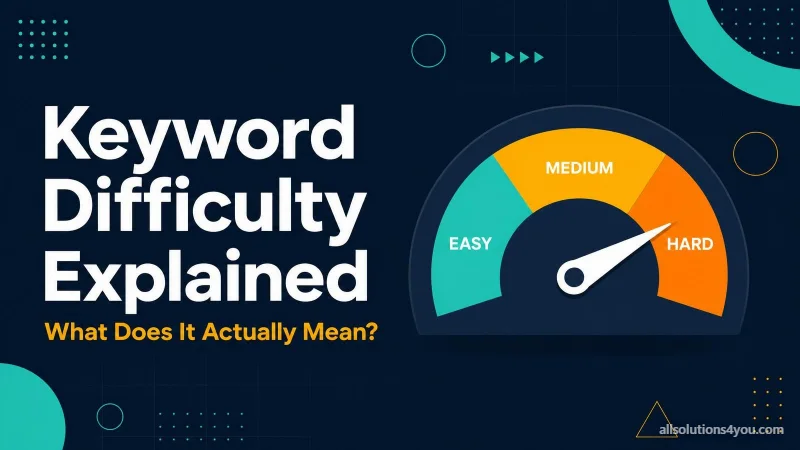
Two tools will give you 34 and 61 for the same keyword on the same day. Neither is wrong, because keyword difficulty is not a measurement of anything. It is each vendor's opinion, computed from their own index by their own formula, expressed as a number out of 100 because a number feels more decisive than a paragraph.
That does not make the scores useless. It makes them useful in a narrower way than most people use them.
The short answer
Almost every keyword difficulty score is, at its core, an estimate of how many other websites link to the pages currently ranking on the first page. Some vendors add other factors. None of them can see Google's actual ranking system, and Google publishes no such metric.
Google does not have a keyword difficulty score. Every number you have seen was produced by a company selling a subscription, from an index they built themselves.
What actually goes into the number
The recipe varies, but most difficulty models are built from some combination of these.
| Input | What it tells you | How reliable it is |
|---|---|---|
| Referring domains to the top pages | How much link support the incumbents have | The strongest input, but only as complete as the vendor's crawl |
| Domain-level authority of the top pages | Whether you are up against strong sites generally | A vendor's own invented metric, not a Google one |
| How consistent the first page is | Whether Google is settled on what the query means | Genuinely useful and often ignored |
| Search volume | How much attention the term gets | An estimate, bucketed, and weakest at low volumes |
| SERP features present | How much room is left for an ordinary result | Useful, and increasingly the thing that decides value |
What the number cannot see
This is the part worth internalising, because it explains most of the cases where a difficulty score misleads you badly in both directions.
- Whether your page matches the intent. A term with a difficulty of 20 is unwinnable if every ranking result is a video and you wrote an article.
- Your own site's standing. Difficulty is calculated about the keyword, not about you. The same 45 is trivial for an established site and impossible for a three-month-old one.
- Brand recognition. People searching a category name and clicking the brand they know is a real effect that no link count captures.
- How good the ranking content actually is. Ten weak pages with strong domains score as hard, and are frequently beatable by one genuinely better page.
- Whether ranking would earn you anything. Difficulty says nothing about whether the searcher is a buyer.
- What the page above you is actually earning. If an AI summary or a set of product listings occupies the top of the page, the first blue link is no longer the first result.
The fourth point is where opportunity usually hides. High difficulty plus visibly poor content is one of the better setups in search, and no score will tell you about it. Reading the page will.
How to read a score without over-trusting it
Treat it as a rough band and a prompt to look, rather than as a verdict.
| Score | Reasonable reading | What to do |
|---|---|---|
| 0-20 | Little link competition | Check it is not zero-competition because it is worthless |
| 21-40 | Reachable with a good page | Where most small-site work should sit |
| 41-60 | Needs authority or a real content advantage | Plausible in year two, or with a genuinely better answer |
| 61-80 | Established players | Only with a specific angle they have not covered |
| 81-100 | Effectively closed | Target a narrower version of the query instead |
Compare scores only within one tool. A 40 in one product and a 40 in another are not the same claim, in the same way that two shops' idea of a medium shirt are not the same size.
The manual check that beats the number
Five minutes on the actual search results tells you more than any score, because you are looking at the thing the score is trying to approximate.
- 1Search the term in a private window, with the location set to where your customers are.
- 2Count how many of the ten results are sites comparable to yours. Two or more is an open door.
- 3Read the top three. Are they good, or merely well-linked? Note anything they fail to answer.
- 4Look at what occupies the top of the page before the results. If an AI summary, a map pack and four ads come first, the first organic position is worth less than it sounds.
- 5Ask whether you could write something that deserves to beat them. If the honest answer is no, the score was never the constraint.
Why our own checker refuses to print a number
A difficulty score is a claim about competition, and competition can only be observed by looking at a search results page. That requires a SERP index and a backlink index, and no free API provides either. We could produce a plausible-looking number from the words in the keyword alone. It would be fiction, and somebody would plan a quarter around it.
So the tool reports what the keyword itself genuinely reveals — its intent, its shape, how specific it is — and states plainly that the difficulty number is unavailable and why. That is less satisfying than a gauge pointing at 62. It is also the only version that does not mislead.
Questions people actually ask
Why do two tools disagree so much?
Different crawls, different link indexes, different formulas, and different scales. A vendor with a larger crawl finds more links and reports higher difficulty. Neither number is auditable, because none of them publish the formula.
Is difficulty the same as competition in Google Ads?
No, and mixing them up is common. Ads competition measures how many advertisers are bidding, which is a commercial signal about the term's value. Difficulty is about organic ranking. A term can be cheap to advertise on and hard to rank for, or the reverse.
Should I only target low-difficulty keywords?
At the start, mostly yes, because early wins compound. But a portfolio of nothing but easy terms tends to be a portfolio of terms nobody valuable is searching. Finding low-competition keywords that bring customers covers how to apply the commercial filter alongside the difficulty one.
Does difficulty change over time?
Yes, in both directions, and often without the underlying competition changing at all — a vendor updating their index or their formula moves every score at once. Do not read a shift in a difficulty score as a change in the market.