Search intent explained: the four types, with real examples
Search intent is decided by Google, not by you. The four types with worked examples, the modifier words that signal each, and how to read a SERP for it.
Entrovix AIAug 20, 2026 10 min read
Most people get intent wrong in one specific way. They decide what a query means, build the page they wish that query wanted, and then wonder why something they consider perfectly relevant is sitting on page four.
Search intent is not a label you assign. It is a ruling Google has already made about a query, published ten times over on the first page, and readable in about ninety seconds. Your job is to read the ruling, not to argue with it.
The two-minute version
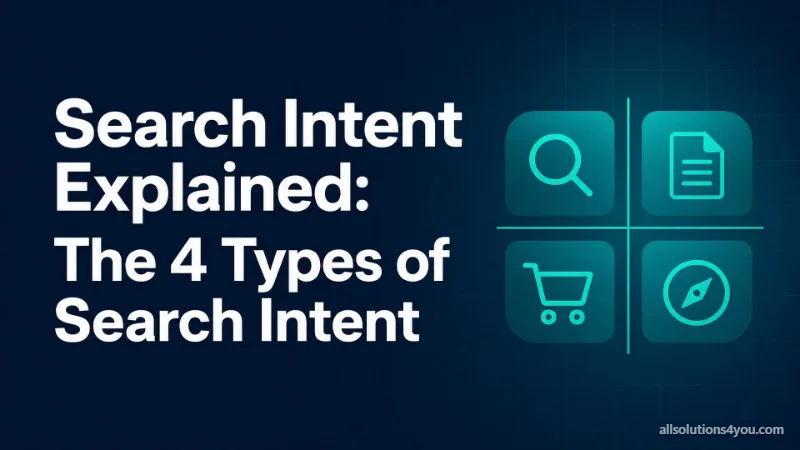
There are four intents behind almost every query. Informational (I want to understand something), navigational (I want to get somewhere specific), commercial investigation (I have decided to buy and not decided what), and transactional (I want to do it now).
To find out which one applies, search the exact phrase in a private window and read what ranks. Whatever format dominates the top ten is the answer. Nine tutorials means the query is informational, no matter how commercial the words look to you. One page does not overturn that, and neither do fifty.
Intent belongs to the query, not to your page
The first page is a record of what has satisfied people who typed that phrase. If ten results are step-by-step guides, then guides are what that audience keeps choosing, and Google has spent years confirming it. You are not being kept out by a technicality. You are offering the wrong thing.
This has a blunt consequence. You do not get to decide that "invoice software" is a buying query because you sell invoice software. You do not get to decide "website cost" is a lead query because you quote websites. Search both, count the formats, and accept the count.
The four types at a glance
| Intent | What they want | What the SERP looks like | What to publish | Realistic conversion |
|---|---|---|---|---|
| Informational | To understand, fix or learn something | Guides, videos, People also ask, forum threads, often an AI Overview | A complete answer, delivered early | Low and indirect |
| Navigational | To reach one particular site or screen | One dominant result with sitelinks, a brand knowledge panel | Nothing, unless the brand is yours | Near total for the brand, near zero for everyone else |
| Commercial investigation | To choose between options | Listicles, comparisons, review sites, ads, some category pages | A comparison that reaches a verdict | Good, and the traffic is qualified |
| Transactional | To buy, book, hire, download or sign up now | Product and category pages, shopping results, a local pack for local queries | The page that completes the action | The highest of the four |
Informational: they want to understand something
The searcher has a question and no wallet open. Sometimes they will buy later. Sometimes they were never going to buy anything, and that is fine as long as you knew before you wrote.
- why is my washing machine leaking from the bottom
- how to calculate GST on a service invoice
- what does a canonical tag actually do
- difference between LCP and INP
- html email not rendering correctly in outlook
The SERP: tutorials and explainers, a video block, People also ask, and on technical queries a forum or Stack Overflow thread inside the top five. Product pages are either absent or buried below the fold, which is the tell.
What wins is a page that gives the answer in the first screen and the detail after. Not history, not definitions of terms nobody asked about, not four paragraphs of context before the number. The pages that beat you here answer the question in the first hundred words and then earn the rest of the read.
Conversion is low by design. Most readers leave having learned the thing, and that is the transaction. Judge these pages on assisted outcomes: repeat visits, tool usage, enquiries that quote a sentence back at you. Also accept that a share of this demand never leaves the results page at all; Search Console added Search Generative AI performance reports in June 2026 with impressions, pages, countries, devices and dates, but no click data whatsoever. If you need revenue attached to a page, an informational query is the wrong place to demand it, which is a different problem from traffic that brings no customers.
Navigational: they already know where they are going
Search is being used as an address bar. The searcher has a destination in mind and wants one click.
- canva login
- hdfc netbanking
- zomato restaurant partner dashboard
- notion desktop app download
- entrovix ai free tools
The SERP: the brand's own page with sitelinks, a knowledge panel, then filler. LinkedIn, news, app stores, and somebody's comparison post at position nine.
There is nothing to win here unless the brand is yours. If it is, the work is unglamorous and worth doing: make sure the pages people are actually searching for, login, pricing, contact, support, are crawlable, clearly titled, and reachable in one click from the homepage. People searching your brand plus a task will bounce hard if they land on marketing copy instead.
The one adjacent play that works is a genuine alternatives or comparison page for a competitor's brand term. Expect to rank below their own result and to receive a small trickle of very warm traffic. Do not expect volume, and do not build a doorway page that pretends to be them.
Commercial investigation: they are choosing
The decision to spend has been made. The decision about what to spend it on has not. For most service businesses and most software, this is the layer where revenue is actually decided, and it is the layer most sites skip.
- best accounting software for freelancers in india
- shopify vs woocommerce for a small store
- zoho books alternatives
- is squarespace good enough for a photography portfolio
- custom web app or off the shelf software
The SERP: listicles, head-to-head comparisons, review aggregators, video reviews, ads at the top, and occasionally one vendor's own comparison page holding a spot. Category pages show up but rarely dominate.
What wins is a page that reaches a verdict. Content that surveys five options evenhandedly and declines to recommend one loses to content that says pick this unless that. Tables earn their place here more than anywhere else, because the reader is running a comparison in their head and you can either help or make them do it themselves. Naming what your own option is bad at moves more people than another list of benefits.
Conversion is good. Not transactional-good, but these readers are weeks or days from buying rather than months, and an honest comparison page routinely outperforms a homepage for enquiries.
Transactional: they want to do it now
Buy, book, hire, download, start the trial. The verb is in the query or one step behind it.
- buy nike pegasus 41 size 9 online
- emergency plumber near me open now
- book dentist appointment indiranagar
- canva pro price india
- hire react developer india
The SERP: shopping results, product and category pages, booking widgets, and for anything local a map pack that takes most of the attention before an organic result gets a look. Blog posts are nearly absent. When one does appear, treat it as a signal that the query is mixed rather than as an invitation.
What wins is the page that completes the action with the least friction: price visible, availability visible, a form short enough to finish on a phone, and no explainer content in the way. A transactional page should not be teaching. If yours opens with three paragraphs about why choosing a supplier is important, it is competing in the wrong category, which is what a purpose-built landing page exists to prevent.
Conversion is the highest of the four by a wide margin. This is why five well-chosen transactional terms are worth more than fifty informational ones, and why they are also the hardest to take.
Modifier words and the intent they usually signal
Modifiers are a useful first pass. They are a hypothesis, not a verdict, and you still confirm against the SERP. But they get you close enough to sort a long list quickly.
| Words in the query | Usual intent | What that means you publish |
|---|---|---|
| how to, why, what is, guide, tutorial, examples, checklist, meaning | Informational | A guide that answers in the first screen |
| login, sign in, dashboard, official site, app, a bare brand name | Navigational | Nothing, unless the brand is yours |
| best, top, review, vs, compare, alternative, for [specific use case] | Commercial investigation | A comparison that names a winner |
| buy, order, price, discount, coupon, near me, book, hire, download, free trial | Transactional | The page that completes the action |
Several common modifiers are genuinely treacherous, and these are where keyword lists get sorted wrong.
| Modifier | Why it misleads |
|---|---|
| pricing / cost | With a brand attached it is transactional. Without one, it is usually informational, and the winning page opens with a range, not a quote form. |
| free | The searcher wants to use the thing on this page right now. An article about free tools loses to a page that is the free tool. |
| a bare head term (software, agency, services) | Almost always mixed. Google shows category pages and guides together because it cannot tell these searchers apart. |
| template | Wants a file to take away, not an explanation of what templates are. |
| near me | Local transactional. The map pack takes the clicks, so your Business Profile and reviews matter more than the page copy. |
| for beginners | Informational even when a product name is attached. Somebody at the beginner stage is not buying today. |
| worth it | Commercial investigation wearing a question mark. The reader wants a verdict with reasons, not a balanced overview. |
When the first page is mixed, Google is hedging
Some first pages are not consistent. Search a term like crm software and you may get two vendor category pages, a definition, two listicles and a forum thread. That is not you failing to read the SERP. That is Google hedging, because the people typing that phrase want different things and the query does not say which.
Treat the top ten as a ballot and count formats. Seven guides and three product pages means publish the guide and put one modest offer inside it. Five and five means there is genuine room for both, and you should own both on separate URLs with clearly different titles and clearly different jobs. That is the opposite of two pages fighting over the same phrasing, which is what happens when you split by keyword instead of by intent.
Mixed SERPs are the best opportunity on a keyword list, for one unglamorous reason: hybrid pages are rare. Almost everybody commits fully to one format. A page that answers the question properly and then, once, shows the reader the thing that solves it can satisfy both halves of a split first page.
Recheck them. Mixed results are unstable. Google confirmed core updates in March 2026 and May 2026, and an update can resolve a hedge in one direction, taking a hybrid page's traffic with it.
The single most common wasted effort in SEO
Pointing a transactional page at an informational query. That is it. More time is burned on that one mistake than on anything technical.
It looks like this. A development company wants leads, so it targets how to build a website with its services page, because the phrase contains the word website and the page is about websites. The page never ranks, because it does not answer the question, and there are forty pages that do. And in the unlikely event it did rank, the visitor is a person who has just decided to build it themselves. They are not hiring anybody this month.
The fix is not to abandon the keyword. Publish the guide, rank with the guide, and place one specific offer where a reader who has just realised the job is bigger than they thought will see it. That mechanic is worth doing deliberately rather than by instinct, which is the whole subject of matching content to intent.
The results are Google's ruling on what a query means. Your page is a submission, not an appeal.
How to check intent in five minutes
- 1Search the exact phrase in a private window, with the location set to the market you sell in. Intent shifts by country, sometimes completely.
- 2Skip the ads. Read the top ten organic titles and label each one: guide, listicle, comparison, product, category, forum, video.
- 3Note the SERP features. A local pack means local transactional. Shopping results mean transactional. People also ask and an AI Overview lean informational.
- 4Open the top two results and look at what the page actually does, not what its title promises. A guide-shaped title on a page that is really a product page tells you the query is mixed.
- 5Write the dominant format beside the keyword. That is the format you are permitted to publish for this term.
- 6Only now ask whether you can win it, which is a separate question about who is already on that page.
Doing this for twenty keywords is an afternoon. Doing it for three hundred is not, so group first and sample each group, and combine the sample with the competition checks in finding low-competition keywords.
Questions people actually ask
Can one page target more than one intent?
Adjacent ones, yes. Informational plus commercial investigation works, because a reader who understands the problem is often ready to compare solutions. Informational plus transactional does not, because the two page structures contradict each other: one needs the answer at the top, the other needs the price and the button at the top. Pick the primary job and let the secondary one live in a section, not in the headline.
How do I tell whether a page is failing on intent or on authority?
Look at impressions against position. Plenty of impressions and a position stuck around 8 to 20 with almost no clicks usually means format mismatch: Google thinks you are relevant enough to show, and searchers keep choosing a different shape of page. Few impressions at all is closer to an authority or coverage problem. Search Console (opens in a new tab) shows both for free, per query.
Does intent change over time?
Yes, and faster than most people recheck. Terms shift with seasons, product launches and news, and the mixed ones can resolve in either direction after a core update. Re-search your ten most important keywords a couple of times a year rather than treating a label from eighteen months ago as permanent.
Do keyword tools label intent accurately?
They guess from the wording, which gets the obvious cases right and the interesting cases wrong. No tool has Google's ruling; the results page has it. Use a tool label to sort a list, then confirm anything you are about to spend a week writing.
Is informational content worth writing if it barely converts?
Usually yes, provided you know what you are buying with it. Informational pages are how a small site becomes a name people recognise later, on a comparison page, when it matters. What they are not is a substitute for having pages that can be found by people ready to buy. Sites that publish only guides get traffic graphs. Sites that publish only service pages get nothing to rank. You want both, in that order of volume and the reverse order of importance.