Your website gets traffic but no customers. Which problem is it?
Two very different faults produce the same symptom. How to tell whether you have the wrong visitors or the wrong page, before spending money on either.
Entrovix AIAug 14, 2026 11 min read
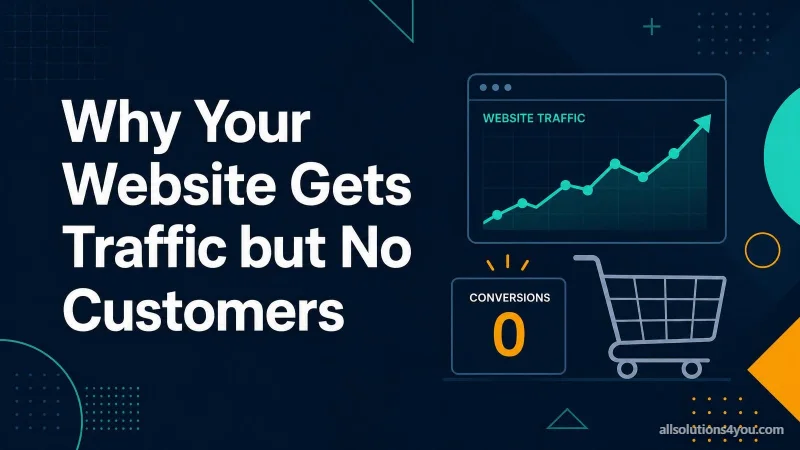
Analytics shows four thousand sessions a month. The phone does not ring. Somewhere between those two facts is a problem, and it is one of exactly two problems with completely different fixes.
Either the visitors were never going to buy, or they were and the site lost them. Spending three months rewriting page copy when the real issue is that all your traffic arrives from a how-to article is a common and expensive way to find that out.
The five-minute split
Open your analytics, list the ten pages with the most entries, and put each into one of two columns.
| If the page is... | The visitor is... | So the problem is... |
|---|---|---|
| A how-to, a definition, a template download | Solving it themselves, or researching for later | Traffic quality. These were never buyers today |
| A service page, a pricing page, a comparison, a location page | Deciding who to hire | Conversion. They came ready and left |
If eight of your ten top pages are in the first row, you do not have a conversion problem. You have an audience of people who are not in the market, and the fix is content strategy rather than button colours.
If your service and pricing pages are getting real traffic and producing nothing, the fix is on the page. The rest of this article is mostly about that case.
Before anything else: are you actually measuring it?
A surprising number of sites in this situation are converting fine and cannot see it. Phone calls, WhatsApp messages and direct emails do not appear in analytics unless somebody set them up to.
- Is the form submission recorded as an event? Test it by submitting the form yourself and checking it appears.
- Do the emails actually arrive? Contact forms fail silently more often than anyone expects, usually after a hosting change.
- Are phone numbers and email addresses clickable on mobile, and are those clicks tracked?
- Ask the last five customers how they found you. If several say the website and analytics shows nothing, you have a measurement problem, not a conversion one.
Check that the form still sends before rebuilding the page around it. It is the least interesting explanation and it is true more often than it should be.
The conversion faults, in the order they usually bite
1. A visitor cannot tell what you do in five seconds
The most common and most fixable. Headlines like "Innovative solutions for modern business" describe nothing. Somebody landing from a search has a specific problem and needs to know within one screen whether you solve it, for people like them, and what to do next.
The test: show the top of the page to somebody outside your industry for five seconds, then ask what the company does and who for. If they cannot answer, neither can your visitors.
2. Nothing on the page makes you credible
A stranger is being asked to hand over their contact details and, eventually, money. Claims about quality and dedication are what everybody writes. Specifics are what nobody can copy: named clients, real numbers, actual photographs of actual work, a case with a before and an after.
3. Too much friction in the ask
Every field on a form is a reason to leave. A first enquiry needs a name, a way to reply, and space to describe the problem. Company size, budget range, how they heard about you and a phone number they do not want to give you are all questions for the conversation, not for the form.
If your form has more than five fields, cut it and watch what happens. The usual objection is that shorter forms produce lower-quality enquiries. That is sometimes true and almost always worth it.
4. The page offers six things to do
Download the brochure, book a call, join the newsletter, follow on LinkedIn, read the blog, get a quote. Every additional option splits attention. One primary action per page, repeated, with everything else visually quieter.
5. The mobile experience is worse than you think
Most traffic is on a phone and most sites are designed on a laptop. Open your own site on mobile data, not office wifi, and try to send yourself an enquiry. Time it. If it takes more than about forty seconds from landing to submitted, that is your conversion rate explained.
6. It is too slow to get to the point
People abandon slow pages, and they abandon slow commercial pages fastest, because there is always another result. This is the one case where speed work has a direct commercial payoff rather than a ranking one. Why your website is slow covers the causes in order of impact.
7. You are asking for marriage on the first date
For anything considered, "get a quote" is a large ask for somebody who arrived four minutes ago. A smaller step — a specific question answered, a guide worth having, a price range published — converts a browser into a contact who can be followed up.
If it is a traffic quality problem instead
Informational traffic is not worthless, but it is a different asset. It builds familiarity and earns links; it does not fill a pipeline this month. If that is most of your traffic, the work is to add content aimed at people who are choosing rather than learning.
- Service pages that are specific about who you work with, not just what you do.
- Pages for the situation rather than the service. People search their problem, not your service catalogue.
- Comparison content, including honest comparisons where you are not always the answer.
- Location pages if you serve an area, because local intent converts far better than general intent.
- Something about price. Refusing to discuss it publicly loses more enquiries than it filters.
Then connect the two. An article that answers a question should link, once and relevantly, to the page for people who would rather have it done. Content that gets traffic and generates leads covers building that bridge deliberately.
A realistic expectation
For a business services site, somewhere between one and three percent of visitors making contact is normal. Under one percent suggests a real fault. Over five percent usually means low traffic that is extremely well targeted, which is a good position rather than a suspicious one.
Do the arithmetic before deciding how much to spend. Four thousand sessions at one percent is forty enquiries. If you close a quarter of those and a customer is worth a thousand, the site is producing ten thousand a month and a week of work to reach two percent is obviously worth it. If your traffic is four hundred sessions of the wrong kind, no conversion work will rescue it and the problem is further upstream.
What to do this week
- 1Submit your own contact form and confirm the email arrives.
- 2Categorise your top ten entry pages as informational or commercial. That single split tells you which problem you have.
- 3Show your homepage to somebody outside your industry for five seconds and ask what you do.
- 4Cut your form to the fewest fields that let you reply usefully.
- 5Complete an enquiry on your own phone, on mobile data, and time it.
If those five point at the structure of the site rather than at any one page, that is a design question. Our website design and UI and UX design work exists for exactly that case, and designing a site that generates leads is the longer version of what changes.