Optimising for Google's AI search: what Google actually says
Google's published position is that no special optimisation exists. What that leaves you to do, which controls are real, and how to measure any of it.
Entrovix AIAug 11, 2026 11 min read
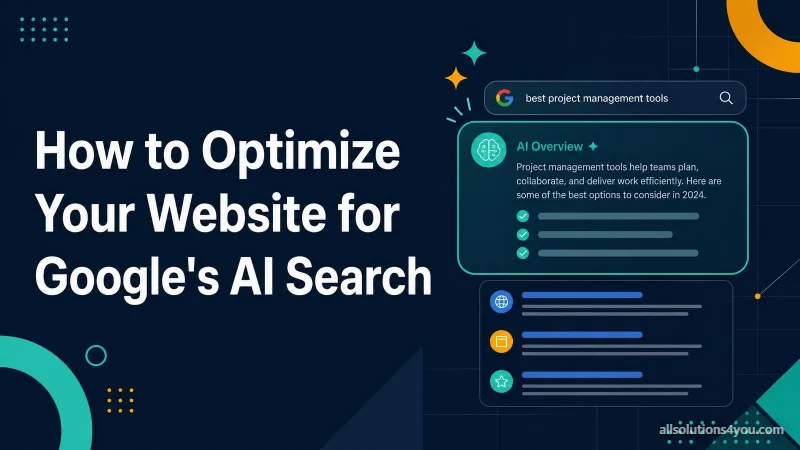
There is a large industry selling optimisation for AI Overviews and AI Mode. Before buying any of it, it is worth reading what Google has published on the subject, because the documentation is short and unusually direct.
There are no additional requirements to appear in AI Overviews or AI Mode, nor other special optimizations necessary. — Google Search Central, AI Features and Your Website
And, in the same document, on the files and markup being sold as prerequisites: you do not need to create new machine-readable files, AI text files, or markup to appear in these features. The full page is Google's AI features documentation (opens in a new tab), and it is worth ten minutes of your own reading rather than mine.
The one hard requirement
Google states a single eligibility condition: to be shown as a supporting link in AI Overviews or AI Mode, a page must be indexed and eligible to appear in Google Search with a snippet.
That has a practical consequence people miss. If you have suppressed snippets on a page, you have also removed it from these features. The controls are the ones that already existed.
| Control | What it does | Effect on AI features |
|---|---|---|
| noindex | Keeps the page out of the index | Removes it entirely |
| nosnippet | Prevents any text snippet | Makes the page ineligible as a supporting link |
| max-snippet | Caps snippet length | Limits how much can be drawn on |
| data-nosnippet | Excludes a specific element | Keeps that passage out while the page stays eligible |
Google has also added a control in Search Console for blocking a site's content from appearing in AI features. If you want out, that is the supported route, and it is a decision to make deliberately rather than by accident.
So what is actually worth doing?
Google's own list of what helps is ordinary and boring, which is the point. Crawling allowed in robots.txt and not blocked by your CDN. Content findable through internal links. Important content present as text rather than locked inside an image or a video. Structured data that matches what is visible on the page. A decent page experience.
In other words, the same technical foundations that decide whether you rank at all. If your pages are not indexed, no amount of AI-specific work applies to you — that is the not ranking diagnosis, and it comes first.
What genuinely changes, and what does not
Saying no special optimisation exists is not the same as saying nothing has changed. Two things have.
Being the answer is worth less than it was
When a summary at the top of the page answers the question, the reader who only wanted that answer has no reason to click. Purely informational content aimed at questions with short factual answers is the most exposed, and it is exposed regardless of what you do to the page.
The content that holds up is the kind a summary cannot replace: anything requiring judgement, anything specific to a situation, anything where the reader needs to trust who is saying it. That is not a new principle dressed up. It is the old principle with the easy cases removed.
Structure helps a machine find the answer in your page
This is the one piece of common advice with a defensible mechanism behind it. A page where a question is answered directly under a heading that asks it is easier to extract from than one where the answer is implied across four paragraphs. That is also just better writing, which is why it is safe advice even if the AI angle turns out to be overstated.
- Answer the question in the first two sentences under the heading, then expand.
- Use headings that state the question a reader would actually type.
- Keep facts, figures and definitions in text, not baked into images.
- Make sure your structured data describes what is genuinely on the page. Marking up things that are not visible is a policy problem, not a shortcut.
Things being sold that Google has said do nothing
An llms.txt file is the clearest example. It has been widely promoted as necessary for AI visibility. Google's Search team has said publicly that Search does not use it and there are no plans to, and John Mueller has compared the idea to the meta keywords tag. The file appearing briefly on some Google properties was a content management system adding it automatically, not an endorsement.
That does not make llms.txt harmful. It makes it an unpaid invoice. The same scepticism is worth applying to anything sold as an AI-specific markup requirement, given Google has stated in writing that no new markup is needed.
How to measure it
Until recently there was no way to see this at all. In June 2026 Google began rolling out Search Generative AI performance reports in Search Console, showing impressions from generative AI features in Search and Discover, broken down by page, country, device and date.
Two limitations to know before you build a report on it. There is no click data in these reports, so you can see that you appeared and not what it earned you. And the rollout has been incremental, so the reports may not be in your account yet.
In the meantime the honest proxy is the one that always mattered: are enquiries holding up? A drop in impressions with steady enquiries means you lost traffic that was never going to convert.
Questions people actually ask
Will AI Overviews destroy my traffic?
It depends entirely on what your traffic was doing. Pages answering simple factual questions are most at risk. Pages that people arrive at while deciding whether to hire somebody are far less exposed, because a summary cannot make that decision for them.
Should I block AI features from using my content?
For most businesses, no. Appearing as a cited source is visibility you would otherwise pay for. Blocking makes sense if your content is the product, and you are choosing to trade discovery for control. Google provides the control; it is a business decision rather than an SEO one.
Does schema markup get me into AI Overviews?
Google says no markup is required. Structured data remains worth adding where it describes real things on your page, because it helps Google understand the page and can produce ordinary rich results. Adding it purely as an AI play is buying a lottery ticket that Google has said is not in the draw.
Is this all just SEO with a new name?
Largely, yes. SEO, AEO and GEO compared works through where the terms genuinely describe different work and where they describe the same work with a different invoice.