Website or web application? How to tell which one you need
The distinction is not size or budget — it is whether people read your product or use it. Getting this wrong is expensive twice.
Entrovix AIJun 30, 2026 7 min read
Plenty of businesses commission a website when they needed an application, and a few commission an application when a website would have done. Both mistakes are expensive, and the second is usually the more expensive of the two.
The distinction that matters
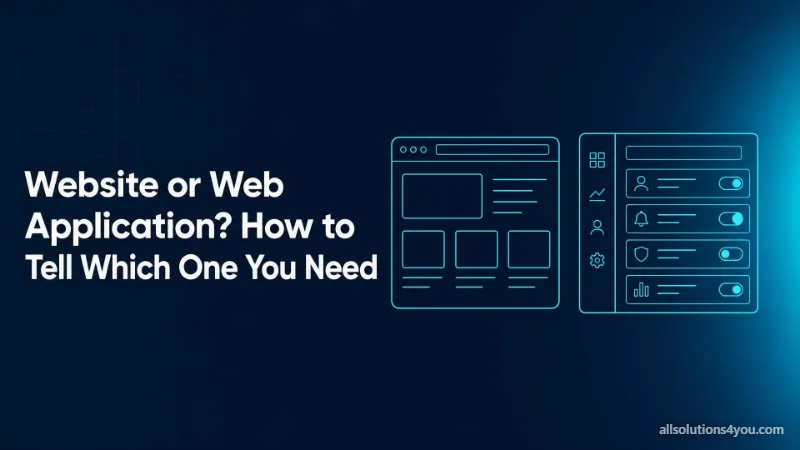
It is not page count, budget or how modern it looks. It is this: on a website, visitors consume information. In an application, users perform tasks that change data.
A restaurant's menu page is a website. The same restaurant's table booking system, where a customer picks a slot and that slot becomes unavailable to everyone else, is an application. The visible difference is small; the engineering behind it is not.
Why applications cost more
- State. Two people booking the last table at the same moment is a problem a brochure site never has.
- Accounts and permissions. Who may see what, and who may change it, is a security surface that must be right every time.
- Data over time. Applications accumulate records that must be migrated, backed up and reported on for years.
- Failure handling. A page that fails to load is an inconvenience. A payment that half-completes is a dispute.
- Ongoing work. Applications are never finished; they are maintained. Budget for that from the start rather than discovering it.
A test that usually settles it
Ask what happens if the site is offline for a day. If the answer is "we lose some enquiries", it is a website. If the answer is "our staff cannot do their jobs" or "customers cannot complete orders", it is an application — and it needs the monitoring, backups and support budget that implies.
The question is not how much you want to spend. It is what breaks when it stops working.
The middle ground most businesses actually need
In practice a great many projects are a website with one application-shaped feature: a marketing site plus a booking form, or a catalogue plus a quote builder. That is a perfectly coherent thing to build, and it is far cheaper than treating the whole project as an application.
The trap is scoping the whole site as though every page needed application-grade engineering. Identify the one or two features that genuinely hold state, build those properly, and let the rest be pages.
Questions worth answering before you brief anyone
- 1Does anyone log in? If yes, you are at least partly building an application.
- 2Does the site need to remember anything between visits?
- 3Can two people's actions conflict with each other?
- 4Does anything need to happen automatically — an email, an invoice, a reminder?
- 5Will your team need to see reports on what happened?
Two or more yeses and you are building an application, whatever it says on the quote. Knowing that before you start is what keeps the budget honest.